Thursday, February 7, 2013

Welcome to Russia!


To Build a Fire is a short story by Jack London that describes an arrogant man's walk from one trading post to the next in the dead of a winter along the Yukon Trail. London is unsympathetic to his central character, as unsympathetic as nature is. At the start of the story an old timer warns the man, if it's fifty below, don't venture out without a partner - better yet don't go out at all. Even the man's dog knew better, but the man goes anyway. And dies.

Not much has changed in the hundred years since that story was written. Caution in the frozen north pays rewards and success goes to those that are prepared and respectful of nature and her awesome abilities. It's been said that nature has nothing to fear from man and that when it is time she will reclaim her birthright. When she does, we humans shall sit down and we shall sleep the most comfortable and satisfying sleep ever known. I digress.

The art of over-preparation and overpacking for these adventures has its consequences. Having frequent flyer status on Delta allows me to carry two bags for free. Aeroflot, a Delta Sky Team partner airline, could apparently give a toss and told me I could only check one bag, the other one I'd have to pay a surcharge for. The pretty brunette counter agent looked at me with solicitude, but made a lackluster shrug that said, "Really, I can't do anything. Decisions need running up the management chain and if the manager won't return my call then, gosh, comrade there's really nothing I can do. You will just have to wait." Initiative, I realized at that moment, relies on trusting people to do the right thing without supervision. Trust is still in short supply in Russia. It will take a couple more generations before the double double checks become the exception rather than the norm.

Eventually I was directed upstairs where I talked with a ticket agent who said the same thing, that my fare allowed only one checked bag. She then sent me over to the check-in clerk who momentarily gave me a little hope that I might get away with it. No such luck. The mousey agent's fearsome middle aged supervisor said 'Nyet!' and I was sent packing to the excess baggage desk manned by the most ferocious looking woman yet. She hit me up for a $70 surcharge and made me feel like I was lucky not to have been arrested as well. 

Cutting back into the boarding pass line I heard someone behind me calling my name, "Mike! Mike!" It was Zaya, my traveling partner for this trip. At the last minute she had decided to abandon her original plan of taking the Trans Siberian Railway from her home town of Ulan Baatar in Mongolia and flew instead. We hadn't seen each other or spoken since we parted ways in Peru four months earlier. After we checked in we spent some time catching up. Zaya is in her heart a romantic, even if she is unsure if she will ever fall truly in love. She wasn't having much success in that department, but was happy to know that I'd gotten engaged almost as soon as I returned home from Peru. I had a feeling her luck was about to change and that someone would sweep her off her feet - if they could only keep up with her.

Wednesday, February 6, 2013

Siberia Calls!

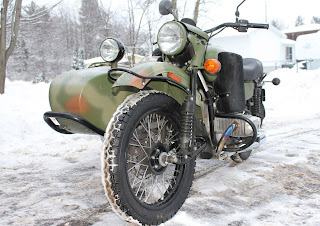
Itchy feet is a chronic condition in my family, and I'm not talking about the athlete's kind. We are in varying degrees a band of wanderers, seekers of adventure with a commonly held curiosity about the world and other people (some would simply call us nosey). My particular strain of this affliction was passed on to me by my grandmother. From when I was about the age of eight we would sit together on the sofa and she would show me photos and tell me stories of her travels to South America and the Far East, all the while inspiring my wanderlust. Whether she would have approved of the idea of driving a 30-year-old Soviet motorcycle from bumf**k nowhere in central Russia 1,800 kilometers northwards to bumf**k nowhere on the Arctic Circle, is impossible to know. But I think she would have appreciated the spirit of the idea.

The Institute of Adventure Research came up with the idea of taking a classic Ural motorcycle and sidecar from Irbit to Salekhard along the zimniks, or ice roads, a couple of years ago. As soon as I heard about the trip I knew immediately I wanted to go on it. My colleague Brendan asked me the other day how many people were planning on going on this journey with me, and I said I thought about 20. To which he replied, "That's probably the entire global population that would have any interest in doing it." I think he’s probably right.

Who is the typical Ice Runner? Well, as you might expect, the group is 90% male, early 30’s on average and damned good looking. A little unexpectedly, 60% of them are Australian, with a large contingent from Perth. Quite why these young men want to leave God’s own paradise at the height of summer and test their mettle in the maw of Russia’s winter it not completely clear. I asked several of them and they said simply, “…to have a go, eh?” Isn’t that what life’s about? Having a go? My grandmother thought so. So do I. 

Friday, February 1, 2013

Ice Run 2013


Red Thread is off to the chilly, frozen bits of Russia in an attempt to drive 2,500km across the Siberian wilderness on an old Ural motorcycle with sidecar. The goal is to drive from Irbit, the home of the Ural, to the only town in the world sitting on the Arctic Circle: Salekhard. We will join 11 other foolhardy teams complete the adventure. Last year folks endured -50C weather, broken motorcycles, wild dogs and drunken locals. This year should be even better.

Click here to donateRed Thread Adventures is about two things, helping those in need and making the world a more interesting place. We raise money for our chosen causes as well as donating our time and expenses to undertake global challenges and inspire others to do the same. For this adventure we are raising funds for our favorite charity, Half the Sky Foundation. There are thousands of kids that benefit from Half the Sky's excellent programs. Please click the donate button on the left or click on the motorcycle on the right and give what you can.

Saturday, October 6, 2012

Finishing's Cool!

Anta, about 1pm and 25 kilometres west of Cusco was the point at which we said goodbye to Fritz with many thanks for all his hospitality and gracious guiding across the Andes. He’d dropped us at the local mototaxi repair shop where things were in a reassuring state of disarray. It was the usual set-up, one guy who knew what he was doing and the rest observing and offering useless advice. The sun beat down through an everlasting dark blue sky. As we explained the symptoms as best we could as our mechanic began the lengthy process of dismantling the engine. Lengthy, because like all the other mechanics we’d dealt with, he divided his time between every job serially; each project getting a few minutes of attention, interrupted by anyone passing by with something new to fix. Eventually, the parts lay before him, the shredded drive gear had blown teeth all through transmission, and he told Zaya that there was no way he could fix the bike until the next morning. “But we need to be in Urubamba by six, tonight!”, Zaya said. They went back and forth until he eventually couldn't resist Zaya any longer and agreed to get it done if he could. He did. By 4:30 that afternoon we were being led out of Anta by a complete stranger and directed along the back roads and the shortcut to Urubamba. Mid-afternoon had turned a little wild, rain and wind, but by early evening the sun began a long golden decline.

We drove alongside Lake Huaypo and some of the most beautiful scenery of the trip. The snow crested mountains away in the distance reflected on the lake, disturbed only by a cool wind. Little did we know that 20 years ago Lake Huaypo was the scene of a mysterious UFO sighting. Two young boys were out hunting frogs when the lake turned into a seething cauldron out of which shot a jet-propelled air mattress. One of the boys was knocked over by the bizarre machine and suffered severe injuries which almost killed him. But that was then and now all we wanted was to get onto the main road and reach the finish line before it got dark and some idiot in a truck ran us down.

The Adventurists’ Department of Crap Maps had outdone itself, but we found the restaurant and our colleagues anyway. It was great to actually drive across the finish line and greet the other teams that had made it ahead of us. Stories were swapped, Pisco Sours were drunk and a gigantic buffet consumed. Silly games were organized and serious drinking ensued. In an homage to Burning Man, the Adventurists had commissioned a giant wooden statue of an Inca god and promptly set it alight with a shower of fireworks.

Partying carried on into the wee hours, but at midnight I took a chance and joined Dave and Hobbit as they headed back to their hotel, which, they assured me, had rooms and was extremely well appointed. They were right on both counts. Peru had given us everything we could have wished for, bar one, Machu Picchu. That was to be the ‘icing on the cake’ as Dave later said. My adventures in Peru weren’t finishing with the Mototaxi Junket, just entering the next phase.

I said goodbye to Zaya at the party assuming we’d see each other in the morning. She was heading down to Bolivia or El Salvador before heading back to the USA for her immigration exam, followed by a quick visit to Mongolia for Christmas. At the end of the party, though, she’d joined a group heading for Cusco and we didn’t see each other again. We managed to catch up via the web later and said our farewells more properly and promised to track each other’s future adventures.

One of the things I most enjoy about traveling with Zaya is her open way with people and perhaps more importantly her genuine interest in them. That makes it easy for strangers to help her find her way through the world. For Zaya little things like money, or the myriad of challenges we faced, are simply hurdles to be overcome, not roadblocks or excuses for inaction. 90% of life is turning up, the other 10% is moving on. I’m sure that one day we’ll see the film of Zaya’s travels – if she ever sits still long enough to edit it.

Vicuñas and Junketeers

Fritz at the helmClimbing quickly we wound our way up to over 4500 meters. Zaya fell asleep and I struggled, between a headache and lack of oxygen, to stay awake. But the high altitude plain was itself a welcome change from the stress of the vertiginous road up. Vicuñas skittishly grazed alongside the highway and were really too cute for words. A relative of the domesticated llama, vicuñas were endangered in the 1960's. With the advent of conservation their numbers have since increased from 6,000 to over 350,000 today. They are prized for their very fine and warm wool. They are also, in my opinion, the prettiest of the Peruvian camelids.

We dropped into Abancay late and halted on a side street near the bus station outside the house of Fritz's extended family - a charming group who plied us with wine and questions. But it was time to rest in a real bed for the night, so we agreed with Fritz to rendezvous at 5:00AM and went in search of a hostel.

The next morning brought us Junketeers! The sun reflected warmly high up the mountain face and blue skies broke through the clouds now and then. Fritz drove us steadily up out of Abancay and I was daydreaming to the local Quechua news when we almost literally bumped into Dylan, Sledge, Dave and Mark. They had traveled together and made it all the way across the country. We shared our tales of mechanical woe and explained why our mototaxi was perched on the back of a lorry and they were collectively sympathetic and a little jealous. This was the last day - Saturday -  and it was the big push for the finish line and the victory party. There was no time to lose. 

Friday, October 5, 2012

Life on the Edge

We pulled into a truck stop on the outskirts of Nazca for a dinner of trucker's fare which we'd become familiar with. Massive portions of good home cooking for very little money. Mine was a pile of rice with a egg on it and a side of chicken and chips for eight soles - about $3.00 US.

After looking around for alternative accommodation it became clear we'd have to share the truck's cabin. Fritz clambered into the upper deck and Zaya and I maneuvered ourselves top to tail on the lower bunk. It was cramped and cold and unfortunately Fritz suffers from sleep apnea. The long pauses between the gasping, rattling snores were barely drowned out by my single remaining earplug. He didn't stop Zaya sleeping, however. Zaya later learned that she had broken her tailbone when she fell through the skylight in Moyobamba. Not only was she in a lot of pain, but she couldn't sit comfortably for more than 30 minutes at a time. Chronic pain is very tiring, so it's no wonder she slept soundly.

4:00AM rolled around way too quickly and it was time to get going again. Having driven trucks in Peru for 40 years, Fritz is a survivor. It is no mean feat to have lived that long on those insanely treacherous roads, especially when you start driving at age 13. Both mornings we traveled with him Fritz followed the same routine. Starting at 5:00AM he walked around the truck, checking the tie downs and tires. Back in the cab, in the half light I watched him as he crossed himself and blew a kiss to the holy spirit. Then he carefully eased into first gear and the big semi started rolling. The bus crash was still fresh in my mind and I was grateful for his routines and his caution.

Fritz had arranged transportation of a load of chickens to a small village outside of Abancay, complete with the chicken wrangler. At the rendezvous I jumped out for a couple of bottles of water and some snacks, then helped load up the chickens. Unbeknownst to me, the chicken wrangler rode on the open trailer between the hens and our mototaxi. Peruvians still know how to have fun like we used to in America. They ride around in the back of open trucks and do crazy things like drive motorcycles without helmets. Truckers pull their seatbelts across their chests, but don't clip in. That's not for fun, though. That makes it easier to bail out of their cab if they go over a cliff.

Thursday, October 4, 2012

Nazca, not NASCAR

Cusco or bust!
Pulling out her sign, Zaya started waving down trucks. It had been years since I hitchhiked anywhere and never with either a Mongolian or a mototaxi.

Sure enough within the hour Fritz pulled over in his huge Volvo 420 truck with a nearly empty flatbed heading all the way to Cusco. Negotiating a price for the ride we would now be in Urubamba by cocktail hour on Friday with enough time to get the taxi running again. Perhaps his name biased me, but Fritz looked for all the world like a 53-year-old Bavarian, short and stocky with a huge stomach and a warm smile.

At first the three of us tried manhandling the mototaxi onto the flat bed. Tying a strap around the front wheel, Fritz tried hauling up while we pushed from below. That proved fruitless and it was clear we needed more manpower. Fritz loaded our bags and after some hand waving we understood that he would tow the mototaxi to wherever we could find enough guys to help out. About five kilometres up the road, with me roped to the back steering the taxi, we pulled over and commandeered five random men to come and help lift the taxi onto the truck. With only a hint of a struggle it was done and once tied down we were on our way.

Our first stop was Nazca, famous for the lines that make long characters in the desert. The origins of the lines are now lost, but speculation includes ancient landing strips for extra-terrestrial beings, massive religious ceremonial sites, and perhaps most plausibly irrigation ditches. The ride up was beautiful in the stark manner of bone-dry desert. There was almost no natural vegetation. The lines run right next to the highway, but by the time we arrived it was dark and all we saw were signs warning drivers of sightseers.

Back to the Grind

Our plan was to be up early. We finally hit the road at 9:00AM - which isn’t particularly early. Zaya was keen to hitch a lift, while I wanted to drive. We compromised. We stood around with our thumbs out for a bit and then drove on to the next town. The PanAm Sur was all but empty as we sped along through the morning’s sea mist past smelly egg hatcheries and oddly abandoned buildings. Our first stop in Chincha Alta was the loo, followed by an oil change and lunch. 

Zaya agreed to keep driving as long as we found a replacement for the rear view mirror Leo had whacked with his head in Tarapoto. Understandably she was uncomfortable with not being able to see over her left shoulder. I had by this time resolved myself to instant death directly from the front or the side, and had pretty much given up looking backwards. The lads from El Chino Automotive were very happy to see us. They plastered our mototaxi in stickers and took lots of group photos with the crazy Chinita and the Gringo. Plus they had what we needed in the mirror department. And I had to admit it, Zaya was right: life was better and safer with two mirrors. 

The bit again between our teeth we headed back south along the PanAm, although now it was simply another bumpy road. Speeding through a peaje (a toll booth from which we were exempt) we grew confident and set our sights on Ica. The sun was warm. Sand and low hills stretched out for miles around us. Dry arroyos left a few shrubs at the corners of the occasional corral. A vulture circled far overhead. All the scene needed was the twang of a steel guitar, a few pieces of tumbleweed and stranger on a horse riding the ridge. 

“Kerpling! Kah-flingah! Plank-ety Plank!”, yelled the engine. “What the…?” “Uh-oh!” Horrible clanking and grinding noises emanated from the motor that suddenly had no ability to generate forward motion. Unsure if we’d dropped the piston, the clutch assembly, or the transmission into the oil pan, Zaya immediately shut down the motor and we bounced quietly to a halt and paused to catch our breath. 

This was the moment I capitulated and accepted that we were done driving ourselves. Our only option was another lift to another town to another repair shop. 

 Off in the distance the vulture cawed to its partner.

Wednesday, October 3, 2012

Kilometre 58

The Pan-American highway forbids pedestrians, horses, bicycles and mototaxi’s, so there we were - living on the edge, fugitives from justice, driving like banshees. Trucks blew by us at speed leaving us wallowing in their wake. In 10 minutes my nerves were fraying and my bottle dropping. I convinced Zaya to take the side road and get off at Pachacámac. Fear had overwhelmed logic: we'd learned the hard way that traffic in small towns in Peru has a special insanity all its own, but at least it was low speed insanity.

We pushed through Lurin and things cleared out fairly quickly. As we entered one of the many beach resorts we had our first real roadside police inspection. The young, uniformed officer wanted all of our papers, asked why we were driving a mototaxi, to where, and examined our cover letter from the Adventurists with insouciant interest. He briefly considered the situation, made his decision and let us go. A little further on our side road petered out and we had to rejoin the Pan Am. By this point trucks were fewer and further between and the going got a little safer.

Kilometre 58 and there was the vehicle inspection station. Trucks wandered in, drivers took papers to a booth, returned to their cabs and the trucks lumbered off. Zaya took what was left of her high visibility orange contact paper and made a sign for Cusco, Ica, or Nasca?, while I mulled over our options, including continuing under our own steam. Friday was the finish line party and it was already Wednesday afternoon. Even if everything went smoothly it would be a stretch to finish before Saturday.

After an hour or so of sign waving and chatting with the inspectors, Zaya found a van driver who said he'd take us as far as San Vincente in Cañete, about 75 kilometres away. From there he said we should easily find a truck heading further south towards Cusco. We piled in.

As soon as we reached San Vincente Zaya found a truck heading to Nasca, but by now all I really wanted was a night's rest in a bed. Negotiating a price with the driver proved difficult. His breath smelled of fish and his three remaining teeth were little more than pegs rattling around his mouth, making conversation incredibly distracting. He wanted 300 soles for the trip, which at that moment seemed entirely unreasonable. It didn't take much to convince Zaya our options would be better in the morning.

After we cleaned up we headed to town for Chinese food and cocktails. We found a bar frequented by a group of drunken civics students (are there any other kind?) keen to practice their English skills. The girls were pretty and the boys were charming, so we chatted a bit until they were overwhelmed by Tequila and we called it an evening.

Lima Redux

Plantains offloaded and Chiclayo toured, we were now heading down the Pan-American Highway towards Lima. Sea mist off the ocean diffused the bright sunlight, but the landscape was as arid as anywhere I’d seen. There’s no shortage of archaeological sites along the coast. While many towns and cities were abandoned 500 years ago thanks to the murderous invasion of the Spanish conquistadors, climate change also played a role in moving populations inland. 

Promptly at 5am we pulled to a stop on Lima’s northern outskirts. We took photos and bid a bittersweet farewell to our traveling companions. Life isn't really about the destination, it's about the journey and the people you meet along the way. Between them Leo, César, and Cyrano had given us of some of the best things Peru has to offer, friendship, food, and adventure. And we couldn't thank them enough.

Still, we needed to get to Cusco by Friday night. Leo told us to head towards kilometre 58 where there was a mandatory inspection point for all trucks heading south from Lima along the highway. It was probably our best chance of another lift. A quick trip to the ATM and several photos later and we were off to do battle with Lima's chaotic morning rush hour. Our now dog-eared map of Peru had just enough detail for us to find our way across the city. 

Traveling in a mototaxi is a piece of motoring insanity at the best of times. When we reached the highway I yielded the helm to Zaya and put my faith in the emergency services. Almost immediately a huge truck blasted its horn and came within inches of my left ear, leaving grit in our teeth and sweat on our palms. We wobbled, but didn't flip over. At the peaje a rather fetching traffic cop thought we were crazy and stupid for even wanting to drive on the highway. Mototaxis were simply not allowed. Eventually, though, thanks to Zaya's persuasion and insistence, she understood our predicament, relented, and let us through. We still had to pay a three soles toll, though.